June 2010

ww2-inspired energy strategy: think twice

Since we posted  The Oil Spill: What You Can Do, we’ve seen lots of websites offering solutions that echo a common sentiment: whether we like it or not, we are all in this together; the risky actions of oil companies are fueled by demand, which we all contribute to. That reminded J.P. Townley of the World War II strategy of conservation in a time of crisis, when EVERYONE had to pitch in, cut back, live with less. Posters asked “Is your trip necessary? Needless travel interferes with the war effort.”Is your trip necessary” applies now more than ever, so Townley designed an updated poster..

We view “Is your trip necessary” as code words for an even bigger question: read more…

dreaming in concrete

Knowing we have a serious thing for concrete, Lydia Wills sent us this picture of a light fixture designed in 1960 by Le Corbusier for the Chandigarth Zoo in India. It’s massive – about a yard across, a yard high and 22 inches deep – yet wonderfully graceful. We’d buy it if had $36,000 to spare (what it went for recently at auction) and could move it. But we’re happy just to have seen it: our view expanded about the possibilities of cast concrete (as Marcel Breuer did once with concrete block).

Like so many things that come our way, the photo of Le Corbusier’s extraordinary light fixture sent us following one idea after another…we started learning about cast concrete, wondering if we could do it ourselves…envisioning not just a Tobias Wong-inspired door stop made by using an Aalto, or other vase, as a mold for concrete…but something BIG (why haven’t we seen any concrete slabs as bed frames? yes, yes, too heavy, we know….)…we were wondering how to get hold of bigger-than-a-doorstop molds for concrete and discovered the Smooth-On Liquid Rubber that can be poured, brushed or sprayed onto whatever you want to make a mold…hhmm… read more…

alliums as alt-summer flowers

Sally Schneider

Last weekend, instead of the usual fabulous summer flowers – sunflowers, zinnias, roses – we picked up our favorite alt-flowers from our farmer friend Keith Stewart. He sells the flowers from his alliums (members of the onion family) like onion, shallot and chive: long green stems topped by white modernist globes.We also buy Keith’s garlic scapes, the vivid green shoots that the forming underground garlic bulbs send up, that curl into beautiful tendrils. Two or three scapes in a vase have a sculptural look that will change slightly daily. Garlic scapes are also delicious to eat. When they are young and tender, we slice them on an extreme diagonal and braise them in extra-virgin olive oil or butter with a bit of water and salt, until they are tender. Their texture is like a string bean with a delicate flavor of mellowed garlic.

Because they are the byproduct of an edible crop, allium flowers usually cost little, last quite a long time, and are wonderful to look at. They have the added virtue of being edible. Allium flowers are really clusters of tiny individual flowers; you can pull them apart to sprinkle in salads… on just about any cooked vegetable…eggs…for a little hit of onion flavor.

Related post: On Tomatoes and Improvising

Little Makeshift Vases

Copy This: Vines and Leafy Vegetables as Flowers

hangable, folding stools and chairs

Ellen Silverman

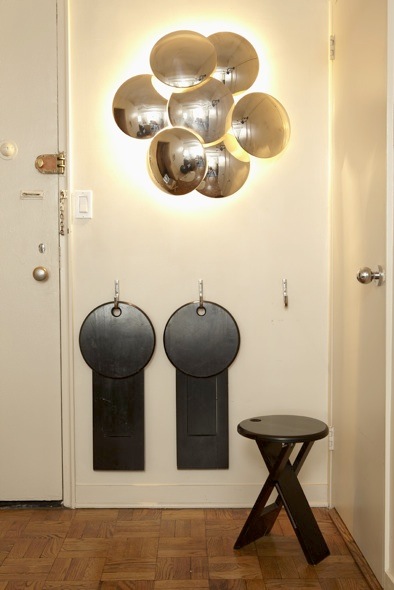
One of the details we loved about Lydia Wills’ apartment, featured yesterday, are the folding stools hanging on the wall in the foyer. They look great, take up no space and are perfect for a million uses, as extra chairs for a dinner party, side tables, a place to sit and take off your boots…On their own, they are lovely little sculptures. They were designed by Roger Tallon in the late ’70′s. Lydia described how she stumbled on the stools and what she discovered about Tallon:

“Roger Tallon started out as a product/industrial designer (watches, electronics, typewriters), but his big thing is that he was a TRAIN designer, very well known for the Mexican underground, a trans euro train, and his biggest deal, the TGV Atlantique (!). I found this stool because he also made a little chair that was designed in a similar way that was an even more beautiful sculpture when folded, but it was too expensive on Ebay, so I just entered his name and then these stools came up one day. Since he did trains, no wonder he came up with these little useful folding chairs.”

Here are images of Tallon’s work (including trains, watches and a spectacular staircase)…We came across the little folding chair that led to Lydia’s stools: read more…

lydia wills’ apartment: before + after + in between

Ellen Silverman

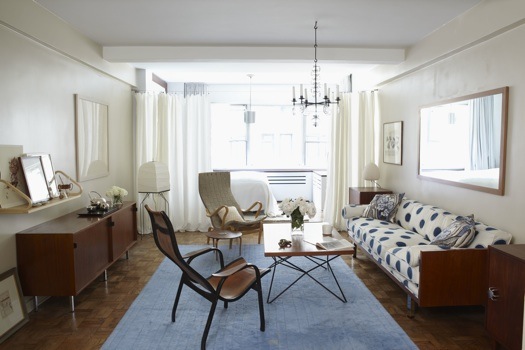
Knowing that Lydia Wills was about to move to a bigger apartment, we enlisted Ellen Silverman to photograph her 600-square-foot studio near Gramercy Park. We’ve known Lydia for years and have watched her apartment evolve into a home with lots of good ideas, far too many to cover in one post. So we thought we’d do the broad strokes now and then focus on specifics during the next few weeks. The real story of Lydia’s apartment is that it slowly evolved, as Lydia did, growing out of one thing and into another, as she discovered furniture, fabrics and lighting that resonated with her life.

Lydia has been sewing since she was young and loves natural textiles, which she used to define the space (often incorporating unusual and vintage fabrics). Over years, she discovered and fell in love with the work of Scandinavian and European Modernist designers. She bought some enduring, beautifully designed pieces of furniture and lighting (mostly on Ebay, for a fraction of their cost), like the leather chair by Yngve Ekstrom, the fantastic table by Bengt Gullberg and the chandelier by Eric Hoglund.

Since there is nothing more gratifying than seeing before-and-after photos, we’ll start with a picture of what this apartment looked like BEFORE, when someone else had it: read more…

wrap and tie a table?

What is it that we love about this? This wrap job is a whole OTHER thing than a mover would do. The use of twine and rope, akimbo, along with the fine lines of the unseen table (which could be made out of anything), turned it into a sculpture. We’re filing that in our heads for future “transformations” we might try on a piece of furniture we’re tired of, or that need something.

via You Have Been Here Sometime

5 ways to make time to improvise

Sally Schneider

Improvisation requires focus and time, two commodities few of us possess. And when you’re waist deep in alligators, it is hard to remember you came to drain the swamp. How can we get focus and time?

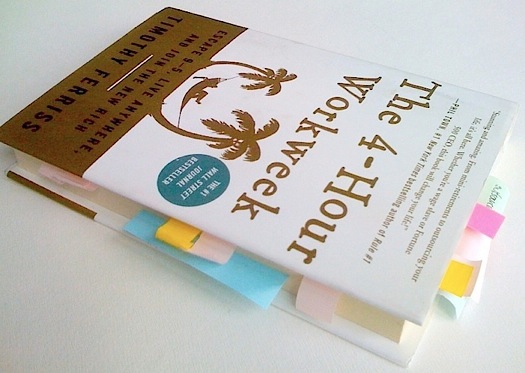
Many people we know have read The Four Hour Work Week by Tim Ferriss. The title appeals to our inner escapist; we dream of an easier life where the focus is on what we really want to be doing, on our family and friends, on what matters most in our lives. The book describes how anybody can be a Lifestyle Designer, and fund their life with only four hours of work a week. That seems a stretch at best. If you have a “hot cakes” book and an online supplement business like Ferris does, maybe it’s plausible. But we’re too distracted and exhausted to start a business. Is such a radical shift necessary to be happy?

We think the real value of this book is as a set of tools that can help you make time to improvise a more enjoyable, less stressful life. Here are our favorite, truly do-able ideas to fight off the alligators and keep focus on what matters: read more…

the brilliant design thinking of everyday india

Pamela Hovland alerted us to a wonderful essay posted on Design Observer recently, called The Subtle Technology of Indian Artisanship; it is about how “everywhere you look in India you will find evidence of the maker’s hand.” A sign painter, faced with a drain opening smack in the middle of his underwear ad, transformed it into a “navel”. The bucket of a massive backhoe (below) is embellished with a welded pattern of metal strips, a bit of beauty in a most unlikely place. Ken Botnick and Ira Raja explore the ways these kinds of embellishments are ”a means of celebrating life” in India; they also explore what it means to be “a maker” – anywhere.

…”on India’s streets, the act of making functional things — cups, chairs, signs, books — is creativity at its most direct expression; meeting a need. Embellishing that object, making it special, requires that the maker take time with the thing to ask more questions, not only about its function, but also about the person who will use it, and about how to distinguish that object from the universe of things that surround it. Embellishing… simultaneously makes the object more reflective of the maker’s distinct personality and brings it into the shared cultural values of beauty and function. Embellishment delights because it surprises. It is found in completely unsuspecting places, like the bucket of a backhoe. It takes ordinariness and celebrates it as if to say, “Hah! You didn’t find this beautiful, this lump of dung, but here it is and it is beautiful.”

We loved learning things you can do with saris that we never imagined, which made us see them in a new way, like this fence made of saris… read more…

anthony giglio’s secret weapon: a china marker for home entertaining

Tara Mann

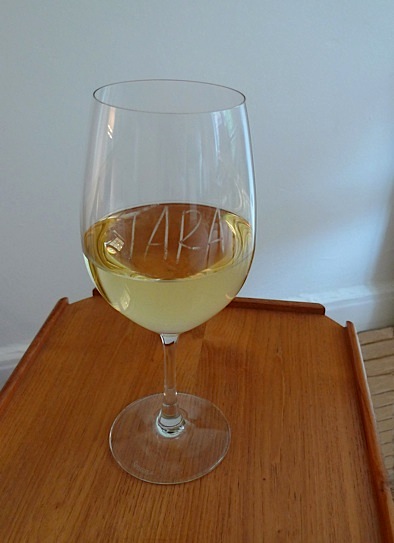
At a dinner party at wine writer Anthony Giglio’s house one evening, we saw him scribble the name of each guest on their wine glass with a white marker: a chic way of helping guests keep tab of their glass in a crowd (and avoiding unnecessary pours – and washing – of fresh glasses).

There’s a brilliant idea, we thought. So we asked Anthony what that marker was and where to get it.

Here is the story of his big fat improvisation, and the many ways you can use it :

“The China Marker is my secret weapon: I bring them to dinner parties as host gifts.

It is not really a marker; it’s a wax or grease pencil -  sort of tacky when you write on paper with it – and writes perfectly on glass or china.

The idea was born at our office for the Food & Wine Magazine’s Wine Guide (back in 2009; I’ve since written 2010 and am writing 2011). read more…

an inspiring early improviser (age 4)

kimono + 7 belts + 7 beaded necklaces + red shoes + heart shades + Mickey cap

!  !  !  !  !  !  !  !  !  !  !

With thanks to Tara Mann (who this is/was in 1995)

hacking cabinet knobs

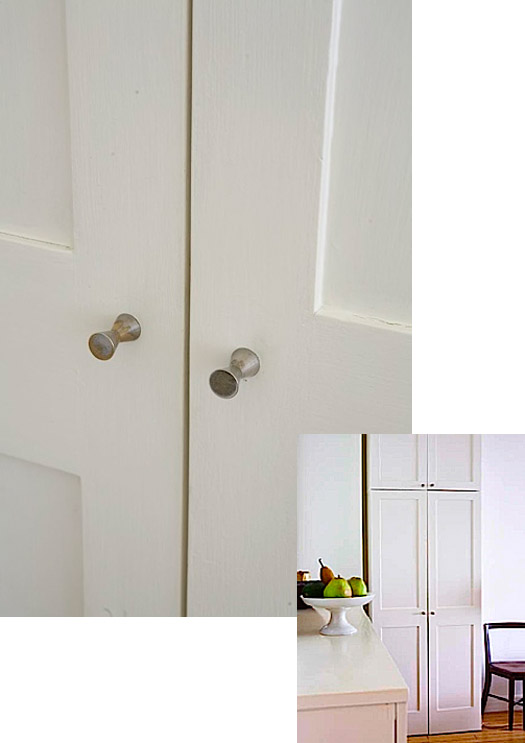
When we were looking around for affordable knobs for a kitchen cabinet we wanted to use as furniture, we spent quite a bit of time hunting for ones that were the moderne shape we liked, only to discover that the finish was awful: too-shiny, too-brassy, too…cheap looking. Since the knobs we found had great lines and were inexpensive, we decided to try hacking them: we sanded them with fine sand paper to take most of the brassy coating off, and bring them down to the base metal (or was it the other way around?). We liked the roughed-up look even better than what we had in our heads.

We LOVE hacking things, customizing them, “overcoming their limits”, as Scott Burnham writes in his the very interesting pamphlet on hacking, “creating new options on one’s own terms”.

Is there anything that cannot be hacked?  As we look around us, we think: It’s pretty much our imagination that limits what we can or cannot hack…

Related post: Kitchen Cabinets as Furniture

sidewalk wisdom: yes we can (dance…anywhere)

Russel S. Lewis

From the always-illuminating Peace, Love and Noticing the Details:

–”Okay, you can’t just break out into dance on the sidewalk.”

–”Yes, I can.”

….Sidewalk voices, one woman to another…

read more…

al fresco music lessons and practice (what do you do in your park?)

We were walking through Prospect Park in Brooklyn one twilight evening when we heard the mellow sound of saxaphones reverberating “a capella” through the trees. We came upon two men standing in a leafy clearing. We stopped to listen, then asked where they were from. The confident man strolling slowly with his alto soprano sax had been a professional musician in Africa and was teaching his friend to play, in the park, where no neighbors would be disturbed. His friend tentatively played notes scribbled on a religious pamphlet propped on the side of his case; the title of his tune “Music in the Air”… read more…

beauty in the defects

Olivio Barberi

via Happy Mundane via You Have Been Here via Apartment Therapy

missing tobias wong

Tobias Wong

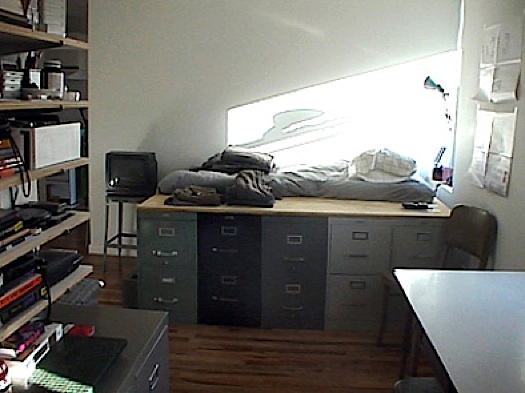
A couple of years ago (when ‘the improvised life’ was just an idea), we stumbled on this picture of Tobias Wong‘s file cabinet bed in Reference Library, and bookmarked it, thinking we’d write a post about it someday. It is such a great, direct idea, with many possibilities for implementing in different ways. But we didn’t think then to follow the little link below the photo, to Wong’s website, brokenoff.com where we would have seen just what a gifted designer and conceptual artist he was. We discovered this in the saddest way possible: reading in the New York Times of Wong’s recent death at thirty-five.

Wong’s work was very much about mocking the pretensions of “great design” in thoughtful, clever, often angry ways. He famously hacked – and mocked – the work of other designers – to their outrage –  for his creations. He coined the word “paraconceptual” to describe his work. “When I do pull a prank, it’s my means of sending out a conceptual idea. It’s not just laughing at them.” Although he didn’t like being called a designer, all of his work had the grace and harmony of good design, while pushing you to think or experience things in a new way, like his Stoop Installation: read more…