In the past month, two dear friends from the tiny hamlet of Helvetia in the West Virginia Appalachians passed away. With them goes a great deal of memory and wisdom and beauty. We’re heading down there to pay our respects, and… just be for a while…in Appalachia’s astonishing spring, as we remember their wild, rich, completely original lives.
“Rage, rage at the dying of the light”. Eleanor Mailloux wrote us this fragment of the famous poem by Dylan Thomas when she was diagnosed with a deadly cancer. She didn’t rage, though. At age 94, she opted for no treatment, spent time with her many friends, and made no bones about the fact that she was dying, which, we realize once again, is a process of pure improvisation.
We thought it fitting to post this wondrous video of a walk along all 2200 miles of the Appalachian Trail, that spans from Georgia to Maine. Using stop motion, Kevin Gallagher condensed a six month journey into five minutes. Watch full screen for a mesmerizing and enlivening walk.
We’ll be back on Monday or Tuesday, depending on the state of our hearts.
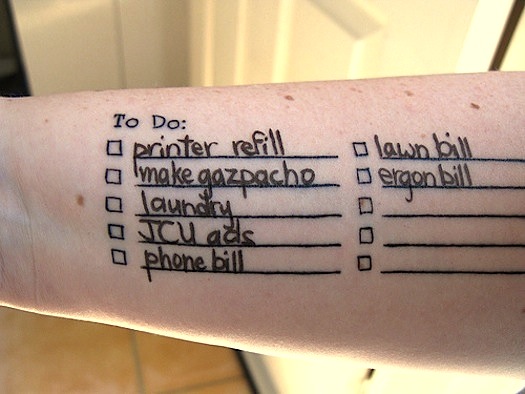
As we’ve been struggling to modify hack Omnifocus,our overly complicated task management software and tailor it to our needs, we came across this fab to-do list tattoo. Just fill it out with a pen daily and wash it off at night. It reminded us of our more primitive – and less permanent – solution: of making notes right on our hands, which we’ve posted about quite a bit. Our favorite: writing power words or symbols in the palm of our hand to straighten out our heads with a glance. You can find out about nontoxic markers here to make your own UNpermanent to-do list tattoo. overdue underdone has a trove on Flickr of his notepad tattoo… read more…
You can “look inside” The Improvisational Cook on Amazon or go to Sally’s website to read reviews and how it came about.“Schneider gives cooks the know-how to embellish, adapt, change, alter, modify and experiment in their cooking with plenty of encouragement and helpful information. Here are the tools and insights everyone needs to find his or own voice in the kitchen…”
For a recap on how to enter (it’s easy!), a few rules AND to read the great entries that have been submitted so far, click here.
We’ve been listening to Homeland, Laurie Anderson‘s great-to-work-to album. The track “Only an Expert” (short version below) reminded us of one of our favorite videos, Jerry-Rigging, reprised from an early, experimental, now-defunct section of ‘the improvised life’. read more…
We’ve always loved the white painted floors that are especially prominent on Scandinavian design blogs and magazines, like these from the home of Danish stylist Sidsel Zachariassen. We wondered what the secret is to making them both pristine and durable. We found the answer in a Dwell slideshow about the smart, frugal renovation of a small two-bedroom apartment by two very clever Finnish designers who weren’t afraid to d-i-themselves.
“It took Susanna several layers of sanding—and then finally tossing her water-based paint and selecting the proper oil-based formula—to get the floor as white as she’d envisioned. But she couldn’t be happier with the result. ‘The apartment looks bigger when there are white surfaces for the light to bounce on,’ she says.”
Patient sanding between coats + the right paint are the keys. Add this information to this great how-to from Real Simple, read more…
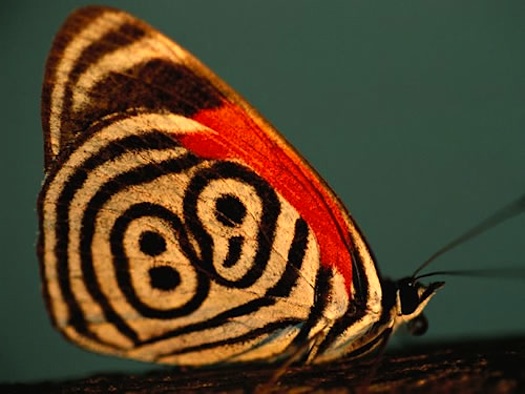
We find the natural world is a good source of design inspiration…like this Eighty-Eight Butterfly (Diaethria neglecta) from Brazil’s Pantanal with it’s a sensational design of lines and dots.
Faced with the possibility of camping in a kitchenless space, we’ve been thinking about ways to forge a makeshift kitchen. Lately, we’ve come across a number of kitchen islands made out of sawhorses and a slab of wood. Although they have a pleasingly ad hoc feeling, sawhorses naturally seem to possess a low-key architectural aesthetic, as witnessed by our many posts on saw horse tables (more below). Unique slabs of wood make for compelling surfaces, like this massive slab of cypress featured in a recent Dwell slideshow. read more…
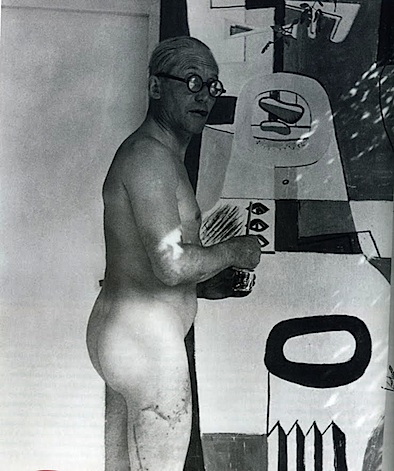
We stumbled on this image of the great architect Le Corbusier painting a fresco in the nude. in Le Corbusier: A Life. He was staying at legendary architect Eileen Gray‘s Villa E-1027 in St. Tropez, in 1927. You can almost feel the Mediterranean breezes.
To us, it is a reminder of “flow”, of following ideas spontaneously and just doing them, in whatever state you are in, in the moment, and enjoying its pleasures…
….jump out of bed and start working, dressed in a tee shirt or…nothing if the situation allows…
The other day we were browsing through Leite’s Culinaria and stumbled on Coleman Andrew’s “recipe” for an ice cream float made with Guinness Stout. It fits fine within the “ice cream with flavorful alcohol” theme we are partial to, vanilla being a perfect foil for the chocolatey/spicy/bitter/maltiness of stout. (Our Amontillado Milkshake walks a similar line of grownup flavors). A Guinness Float is a brilliant play on the classic float idea: ice cream with something fizzy poured over, like root beer, or Coke.
Andrew’s divine and very grownup dessert is not really a recipe at all; it is more an equation:
really good vanilla ice cream like Haagan Daz’ Five Vanilla Bean + any really well-made RICH dark stout beer
(It couldn’t be easier to make: you spoon ice cream into a glass and pour the stout over, then eat with a spoon).
Over the past week, we’ve stumbled on some very cool housewares with all the qualities we value: simple, well-designed, enduring, and good value. Our favorite is a charming geometric textile made of pieced Tyvek by Woodnotes that can be used as curtains, partitions, and table decorations.“Flake consists of snow flake like pieces which are joined together simply by slipping the point of a flake through the hole of another flake. You can create a compact or a net like, loose surface. Three-dimensional forms are also possible.” (Woodnotes also makes a variation on the pattern called Flowers.) We love that we can work with the material ourselves, vary the texture and size, fool around, see where it takes us. We’re thinking room divider…or a pleasingly revealing shower curtain.
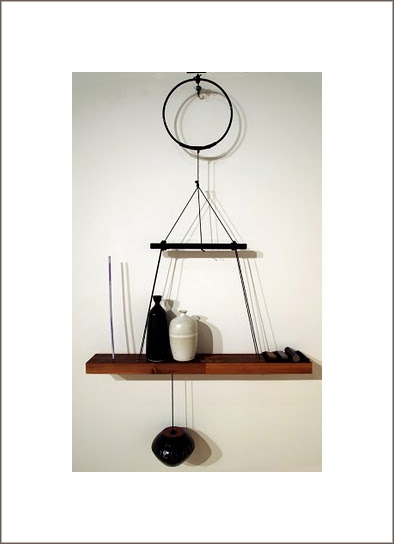
In our minds it’s art = a shelf = art = a shelf = wonderful to look at = practical = odd =art = a shelf….
The gist is really a wood slab and rod bored with holes through which to run rope or wire, elaborated on with a big metal ring, a hanging counterweight and the rod that sticks up for no apparent reason (which we love). It made us want to hunt down odd bits and start rigging them…
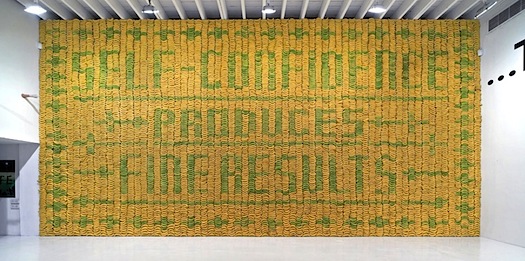
…a fab sign made of bananas by Austrian graphic designer Stefan Sagmeister’. It’s part of his new exhibit of his commercial/commissioned work at the Mudac Museum in Switzerland.
Cherry, apple blossoms and dogwood will soon be making their appearance, so Spring is a fine time to practice ikebana, the minimalist art of flower arranging that originated in Japan. As with wabi-sabi, although it looks simple, it has complex philosophical, even spiritual underpinnings.
Ikebana” is from the Japanese ikeru (生ける?, “to place, to arrange, life, birth”) and hana (花?, “flower”… It is a time to appreciate things in nature that people often overlook because of their busy lives. One becomes more patient and tolerant of differences, not only in nature, but also in general. Ikebana can inspire one to identify with beauty in all art forms. This is also the time when one feels closeness to nature which provides relaxation for the mind, body, and soul.–Wikipedia (we wish we knew WHO wrote this)
We thought we’d offer a bit of inspiration: Isamu Noguchi ‘s “Lonely Tower” – Shigaraki stoneware with thin ash glaze made in 1952 – with ikebana by Teshigahara Sofu.
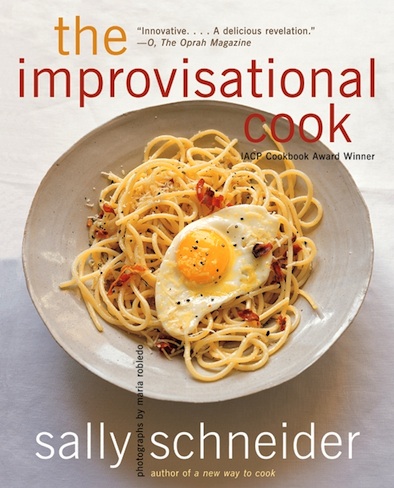
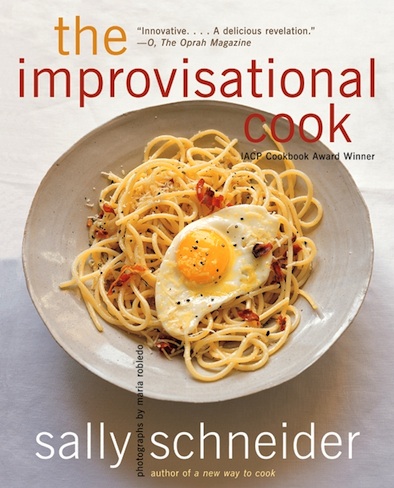
We’re giving away a free copy of Sally Schneider’s award-winning cookbook The Improvisational Cook (inscribed by the author if you like), widely viewed as THE book about improvising in the kitchen.
“Schneider gives cooks the know-how to embellish, adapt, change, alter, modify and experiment in their cooking with plenty of encouragement and helpful information. Here are the tools and insights everyone needs to find his or own voice in the kitchen…”
To enter, all you have to do to enter is write a Comment (in the form at the end of this post) telling us of a kitchen improvisation you’ve attempted. Tell us about a dish you’ve made, a unique flavor combo you discovered or even a piece of equipment you’ve rigged. If you’ve been flat-out afraid to improvise, you can enter as well, just tell us the gist. Success or “failure” doesn’t matter, though we’d love to know a few juicy details, what motivated it, what it consisted of, and how it turned out...The winner will be chosen by random.org. read more…