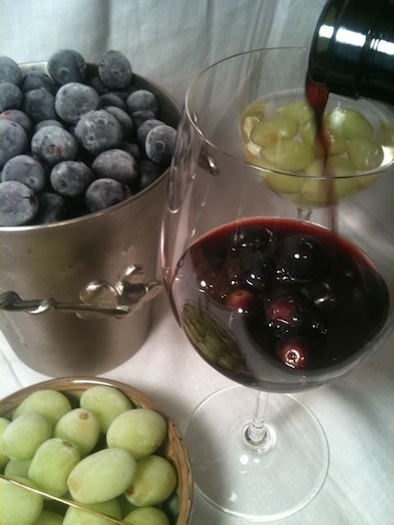
Practically every wine-loving American I meet – even those who say they don’t know much about wine – is sure of one universal “truth” that couldn’t be farther from it: Red wine should be served “room temperature.” What does that mean? And who said so?
Poking around in old British wine books from the Victorian era, I can only imagine that our wine-loving forefathers, taking every viticultural word from Europe as Gospel, embraced the idea of “room temperature” from men wearing wigs and capes in freezing-cold London. Before modern heating, few homes reached today’s “average” room temp of 72°, except during summer months. Especially in London.
But ask any sommelier worth his or her spittoon what the proper serving temperature is for red wines, and they’ll tell you between 55° and 65°. Where’s the disconnect? It seems to be a translation error: somewhere along the line, “cellar temperature” morphed into “room temperature.” Proper wine storage is around 55° -“cellar temperature” – which also happens to be a great temperature to serve light-bodied reds, like Pinot Noir, Gamay/Beaujolais and Cotes-du-Rhone. The maximum serving temperature for the most full-bodied reds is 65’, well below modern-day room temperature. All red wines of all body weights taste best when served in between those two numbers.
What does all this mean? You can, and should, chill your wines read more…
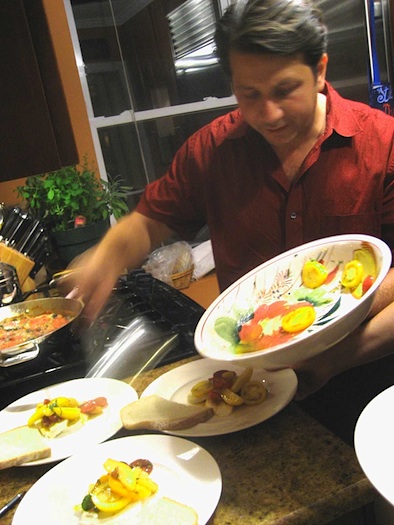
Our friend Anthony Giglio is a journalist, sommelier, and the author of many acclaimed books on wine and cocktails, including the Food & Wine Magazine’s Wine Guide 2011. He travels around the country leading wine tastings and helping people navigate the vast world of wine, cocktails, and “what goes with what”. He does all of this with a sense of humor that borders on irreverent, often shocking connoisseurs with his candor. A great cook, he is also one of the best dinner party hosts we know – invitations to his parties are coveted! – largely due to his ability to put himself in his guest’s shoes and think of ways to delight them from the moment they walk in the door. (He taught us Mama Lucia’s Insalata di Pomodoro, THE best approach to real summer tomatoes, which he’s dishing out in the photo above.)
We’ve been so impressed by his smart, simple strategies for entertaining that we’ve asked him to guest blog for ‘the improvised life’, starting with read more…
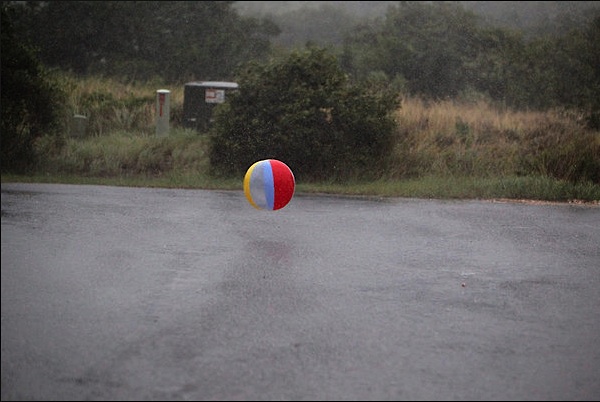
We found this photo of a beach ball suspended in air on the New York Times’ slide show of Hurricane Irene pictures. That’s us, we thought, as we take some time to….stop…let ourselves be suspended…for this last official week of summer.
We leave you with a swell post by our new contributor Anthony Giglio, perfect for Labor Day weekend (it will follow this one.) We’ll be back on Tuesday afternoon (the 6th).
When we last left our New York City taxi farmers - the car service drivers who plant “crops” in vacant patches of land around the Bronx – they were gamely waiting for their urban garden to grow, even as they waited for calls from the dispatcher.
Well, it’s been a tough harvest in the city, as it has been for farmers everywhere. Last year, as we reported, it was the torrential rains. This year, it’s been the withering heat. Our intrepid drivers lost their first planting, but they didn’t lose heart. read more…
…the Great Hurricane of 1938 roared ashore while Katherine Hepburn was out playing golf in Fenwick, Connecticut: there was no radar or satellite to warn of what appears to have been a Category 4 hurricane. Somehow, she rode out the storm, although it destroyed her family’s summer home. Most of her belongings were lost or destroyed; an Oscar she won was found in the rubble. read more…
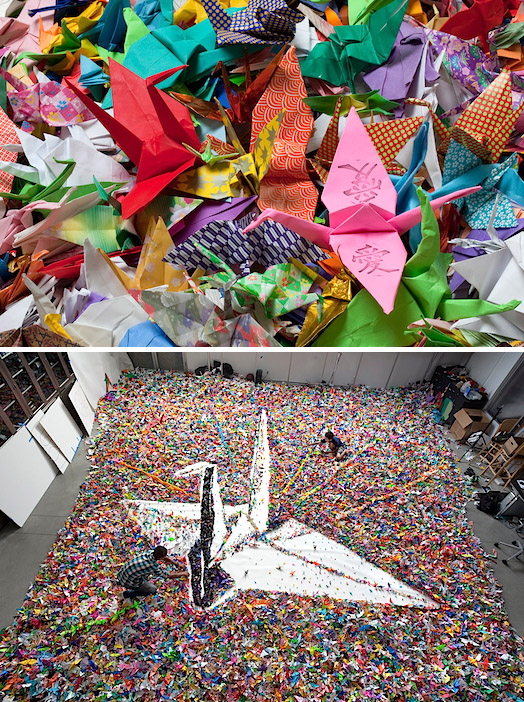
After the Japanese Earthquake in March, the nonprofit Bezos Family Foundation invited children to mail origami cranes to the Seattle headquarters of its Students Rebuild program. Each would trigger a $2 donation, up to $200,000. The group received more than 2 million and doubled the donation.
Last July, a truck full of the origami cranes was delivered to the Brooklyn studio of Brazilian artist Vic Muniz. The trove contained cranes from 38 countries, made out of all manner of foldable materials: hall passes, math homework, love letters, saran wrap, candy wrappers, restaurant menus, aluminum foil, vocabulary lessons, Kleenex. The smallest was the size of a thumbnail.
Muniz created a giant 36 x 40 foot mosaic out of them for a fund-raising poster. Said Muniz:
It’s alchemic. The idea worked because everyone wanted to help.
…bits of folded paper became symbols, that raised money, that help people in need, and became an artwork that raised money that….
(Video link here.) Hans Namuth‘s Jackson Pollock 51 is ten illuminating minutes of the abstract expressionist painter at work at his studio on Long Island. Pollock’s sparse words annotates his process in real time: simple declarative statements that give wonderful insight into an original, creative mind, like the idea that reacting against someone or something can be a way of discovering one’s own voice: “At the Art Student’s League…I studied with Tom Benton. He was a strong personality to react against.”
About halfway through, Namuth filmed Pollock making a painting on glass, filming from below to view Pollock through his glass canvas. An extraordinarily intimate view.
Read more about Namuth’s experience filming Pollock at Open Culture.
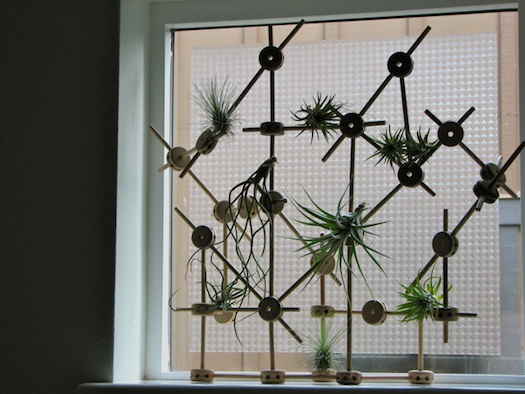
We totally love this collection by of elements and connectors for making whatever you want, designed by Louise Cohen. It is like a perfect fusion of built-it-yourself Lego/Tinkertoy/K’nex/ErectorSet-esque material for adults.
The CREATE YOUR OWN Collection is a building system consisting of 18 galvanized elements and 5 kind of connectors. According to individual desires unique living accessories can be composed.
Constructions for all kind of purposes can stand, lay or ride, hang from wall or ceiling. read more…
Since we’ve been hanging out with our friend Ana, helping her fix up her place in Harlem (more on that soon), we’ve noticed that people in the neighborhood love to hang out on the street. We see men sitting on folding chairs at card tables playing poker, and families on stoops, and there’s alway a crowd around the bike repair place, where a chess game goes on in the midst of the fixing and conferring.
Recently we spotted these makeshift seats: boards cleverly wedged under the fence along Marcus Garvey Park to create a leverage effect and seats with backs. Someone even thought to bring a pillow. It’s the perfect, impromptu way for two friends to hang out on a summer day.
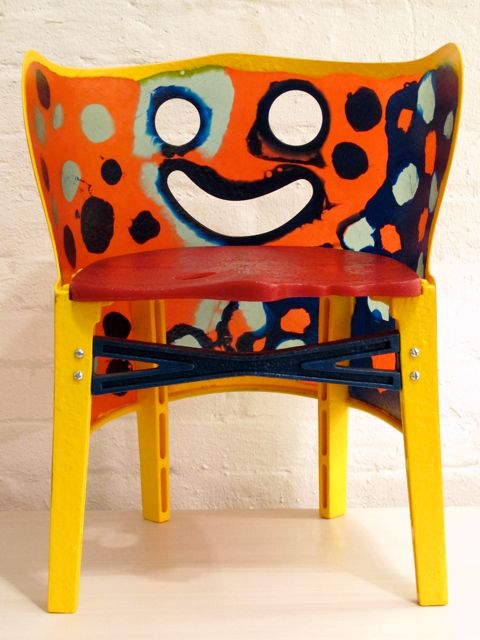
For a fat, liberating dose of inspiration, check out the long riff on Mondoblogo of chairs Italian Designer Gaetano Pesce painted in the nineties for his kids.
His “Open Sky” chairs are out-there, fun, wild, loose, and awesomely beautiful… read more…
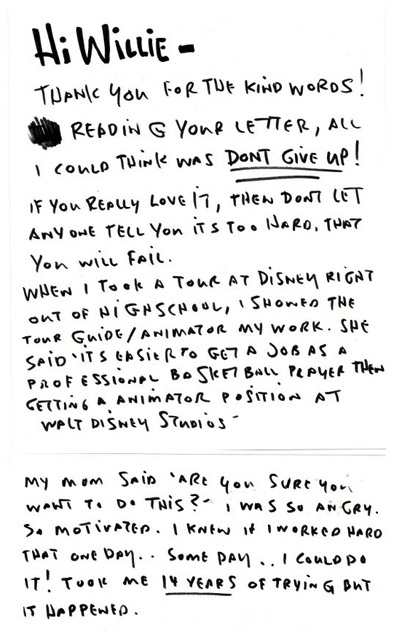
The Animators Letter Project was started by Willie Downs, an animation student who, just a year ago, was an aspiring animator pursuing a career he knew wasn’t right for him. Petrified of the risk he would be taking in dropping out of an expensive and presumably more reliable degree program to attend animation school, Downs wrote to two animators for advice. One particularly inspiring response from Aaron Hartline at Pixar said “Don’t give up!!! and sparked Willie to start his blog project, asking other animators to write letters to aspiring animators, offering advice and encouragement. Now that project has morphed into The Inspirational Letters Project.
What’s great about these letters are how easily they translate—many of the letters contain nuggets of inspiration for anyone taking a career risk or running up against a wall in their job. Our favorite is this letter from animator Austin Madison in which he comes clean about what may be the eternal truth of a lot of creative work: 3% of the time you are on fire, and 97% of the time is a messy slog. The key: persist, despite all the difficulties… read more…
Time Magazine has come out with their 50 best websites of 2011. We find that their lists are often chock full of useful stuff—last year’s list introduced us to Wakerupper, which schedules wake-up calls (.5 each after a few free ones) which we rely on to stop pressing the snooze alarm and get us out of bed).
Here are our top five from this year’s 50: read more…
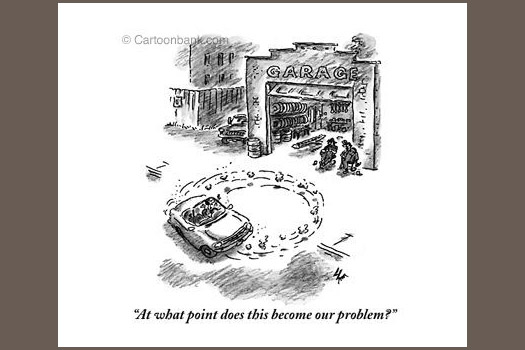
When our friend Andrea Raisfeld sent us a compelling scan from Malcolm Gladwell’s piece Creation Myth in the May 16th issue of The New Yorker, we went online to find the story and explore its ideas more fully. In the process, the post we intended to write about the creative process turned into a post about bad design.
While trying to use the New Yorker’s digital archive (as print subscribers, we theoretically have access) we inadvertently encountered an avalanche of ill un-considered technology. Our established password didn’t work, even when we reset it; the website didn’t recognize the email address we’ve used for years. Our first three emails to Customer Service went unanswered (There is no phone number for Customer Service on their Contact Us page). Then we began to receive robo-messages repeating the same instructions after each subsequent email asking for help. When we finally created a NEW account on our desktop, it would not work on our iPad.
Finally, we sent a very specific email outlining our experience and wrote HUMAN BEING PLEASE in the subject line. We got another non-sequitur robo-message, repeating previous instructions, this time signed “Shar”.
For ten days running, the digital New Yorker broke the record for website glitches, ineffective instructions, horrific customer service and pure wasted time. Bad design.
Our experience mades us hate a magazine we love. That’s REALLY bad design. But it also made us realize the simple key to good design (of anything): read more…
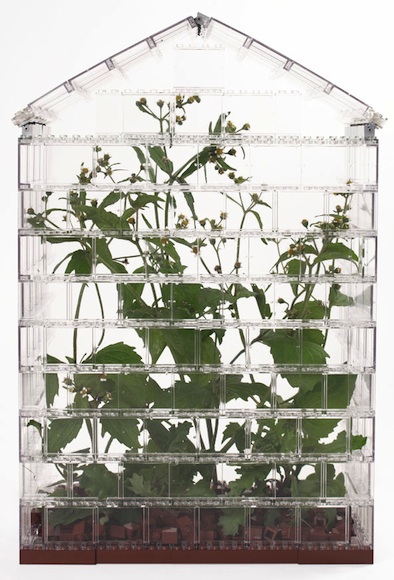
We are slightly obsessed with the idea of using Lego’s to make functional objects that we can really use; it’s kind of a mindgame we play with ourselves that we hope to put into action one day, since you can now buy as much of any color Lego as you want at Lego stores across the country. We are inspired by two recent finds: London-based designer Sebastian Bergne‘s Lego greenhouse, that has live plants and vegetables growing within.. read more…
(Video link here.) We recently came across this great talk by Joshua Foer that explores the success of “experts.” The video is 17 minutes, which we know is long, so we’ve culled the gist for you, hoping you’ll listen at some point; we think it’s truly useful and super interesting.
According to Foer and the scientists he draws from, becoming an expert has a whole lot more to do with psychology than innate ability. We generally push ourselves to achieve at a given skill only up to the point at which we can get the job done. Foer uses the example of typing—most of us type for at least an hour a day, yet we don’t get measurably faster…we settle into a speed we think is good enough. We hit an “OK plateau.”
Psychologists who study skill acquisition have found that experts across a wide variety of fields know that you can’t improve at something as long as you’re stuck on the OK plateau, and routinely use the four strategies below to ensure that their minds continue to climb uphill, so to speak. Even if you’re not striving to become an “expert” in your field, we think these strategies are helpful for anyone trying to pick up a new skill or practice, or get better at an old one. Here they are: read more…