“Keep on the Sunny Side”, written in 1899 by Ada Blenkhorn, made famous by The Carter Family…
…if that’s not your cup of tea, let Louis C.K. inspire you to ROCK OUT (even if everyone else thinks you’re an idiot) read more…
“Keep on the Sunny Side”, written in 1899 by Ada Blenkhorn, made famous by The Carter Family…
…if that’s not your cup of tea, let Louis C.K. inspire you to ROCK OUT (even if everyone else thinks you’re an idiot) read more…
We’d figured we had alt-easter gift covered for this year with our seedling-filled Easter eggs, when Cynthia from 50Years50Recipes sent us ANOTHER swell, novel gift. She stuffed plastic eggs with goodies and sent them through the mail, as an invitation to her her niece and nephews to come for an Easter visit (She got the idea from Giverslog.) We were under the impression that the increasingly restrictive postal system had banned oddly shaped packages years ago. Writes Cynthia:
The eggs did arrive, but it took 10 days to get from one end of Mass to the other and two weeks to get from western Massachusetts to upstate New York. So the good news is it works-the downside is that even with first class postage it takes a bit of time.
I also tried the filled bottles mentioned on Giverslog read more…
We’ve just discovered The Paris Review’s blog, and some cool and illuminating posts. A recent one by Leslie Jaimison is called Frida’s Corsets:
Frida Kahlo wore plaster corsets for most of her life because her spine was too weak to support itself. She painted them, naturally, covering them with pasted scraps of fabric and drawings of tigers, monkeys, plumed birds, a blood-red hammer and sickle, and streetcars like the one whose handrail rammed through her body when she was eighteen years old. The corsets remain to this day in her famous blue house—their embedded mirrors reflecting back our gazes, their collages bringing the whole world into stricture. In one, an open circle has been carved into the plaster like a skylight near the heart.
Kahlo, confined in terrible casts most of life, painted them, transformed them, took them over as much as she could, turned them into something beautiful, expressive; she turned them into art. read more…

DrinkEatTravel
In honor of St. Patrick’s Day, we thought it fitting to reprise the Stout and Ice Cream Float post we published a year or so ago. It is a one line equation-of-a-recipe adapted from Coleman Andrews:
Into a big glass, spoon really good vanilla ice cream like Haagan Daz’ Five Vanilla Bean, then pour over Guinness or any really well-made RICH dark stout beer; then eat with a spoon.
The possibilities for using different stouts are vast. Check out Beer Advocate’s list of 750American Stouts.
If you are not a Guinness fan or a fan of America’s version of St. Patrick’s Day, you will be once you’ve tasted the float!
It is a perfect grown-up dessert, anytime.
Photo from Drink Eat Travel‘s feature on Kern River Brewery.
Related post: amontillado and other grownup milkshake(s)
quick homemade tropical ice creams (banana..mango…)
smoky, bacon-infused spirits for holiday cocktails
cream biscuits: easy, foolproof and divine (recipe)
the potato chip improvisations + recipe: real onion dip
(Video link here.) Our friend Fast Forward sent us an illuminating post from Gilttaste called “What Makes Sushi Great”. It’s about newly released film, “Jiro Dreams of Sushi”, about Jiro Ono, 85 years old, a revered sushi chef and one of Japan’s Living National Treasures who runs a tiny, legendary restaurant inside a Tokyo subway station:
“…the movie focuses on the life of a man who is utterly devoted to his craft. Jiro doesn’t have a secret to why his sushi is more astonishing than anyone else’s. What he says, over and over, is that great sushi—and, by extension, greatness itself— is the result of hard work, of dedication, of a commitment to excellence that, in the end, trumps everything else in life.
His search for perfection is eternal. At 85, he hasn’t stopped working; he says he hates holidays because they are too long to spend away from the restaurant. Chefs, in particular, who have seen the film don’t hesitate to call it “inspiring.” To watch the gorgeously shot scenes of him forming pieces of sushi, jewel-like and dripping with soy sauce and life, is to wish that you might one day make so much beauty. (Indeed, a film critic friend said that her reaction to seeing this was not hunger, but to want to go home and make jewelry.)
… Still, there is another side to this mastery…” read more…
Last Easter, we posted Ambatalia’s extensive how-to on dying Easter eggs with natural dyes. We have that essential Easter item covered. What to do THIS year? There’s egg-shaped stones painted a la Max Ernst…
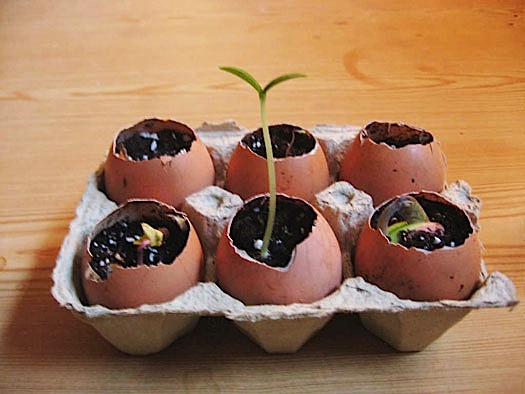
Then an image we saw in a Remodelista post about cold frames got us thinking about another kind of ALT Easter eggs. We discovered that halved egg shells are sometimes used as starter pots for seeds to sprout in (supplying the plant with a nice dose of calcium). We thought: wouldn’t a carton of eggs with little seedlings growing in them be a wondrous and surprising Easter gift? Why not?
The process is pretty simple: crack and empty the eggs*, fill with potting soil, add the seeds… Instructables has clear directions and a PDF. If you start planning now, we figure you’ll have some charming little shoots in time for Easter, on April 8th. (See packages will give you a sense of how long a particular seed takes to sprout; beans and cucumbers only take a few days.) read more…
We’re always on the lookout for interesting painted floor ideas and love this modernist pattern painted onto the naked wood. This ‘freeform’ design would have to be done with care, with a series of stencils, we imagine, shapes carefully cut out of big sheets of thin but firm plastic.
We started to imagine other “moderne” designs that would be great on a floor and thought of the great Alvin Lustig, who designed book jackets, textiles, magazines and interiors in the 40′s and 50′s. The graphic elements from these book jackets these be swell: read more…
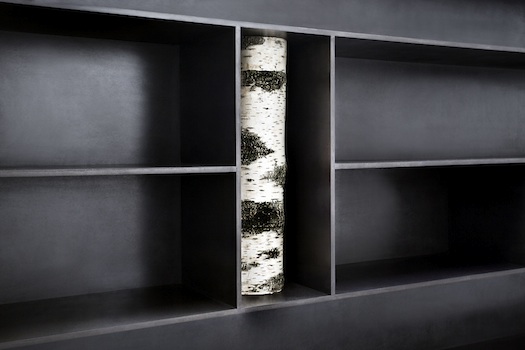
Recently, we’ve seen bundles of birch logs being sold at delis around New York City: cheap enough for an evening’s cozy fire. Since we don’t have a fireplace, we’ve admired them as a lovely, elemental raw material – right on our doorstep – and mulled what we could do with them; we’ve been meaning to buy a pack just to have and see where they took us.
This morning we came across this shelving unit designed by architect Andrea Branzi - a simple birch log inserted into a simple black bookshelf, that makes for a charming and surprising visual.
So now we ARE going to go out and buy some logs before they’re gone with winter. read more…
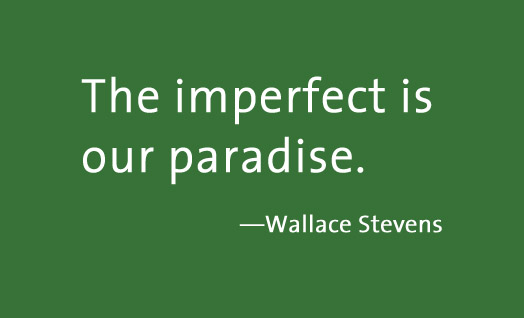
We were talking about imperfection, wabi sabi, and how messy the creative process is when, out of the blue, David Saltman said “The imperfect is our paradise.” He looked surprised and then said “Wallace Stevens.” He had called up from memory the best line of a famous Wallace Stevens’ poem called The Poems of Our Climate.
We looked it up. It was a little difficult at first, until we read it out loud. O-h-h-h! It became clear as a bell.
So we looked for an audio file to post here, so you could listen to this incredible poem that is about where we humans really live. We think it is a lovely way to start the day (poems often are, as we discovered a while back, and wrote about.) We couldn’t find a recording of it anywhere. So you’ll have to read it out loud yourself, or just stick with that one true and dazzling line, above. read more…
Recently the New York Times ran an interactive feature about Osteria Senz’ Oste, an inn 40 miles or so north of Venice whose name translates “Tavern Without Host” or “Inn Without Barkeep.” The proprietor Cesare De Stefani wanted to create a space that “felt like home”, so he trusts people to pay what they wish for the superb local prosecco and salumi he serves there. The piece was photographed by Todd Selby of The Selby, who is known for honing in on specific and unique details of a space.
We were charmed by this image of visitor’s notes tacked up on a wall.”Why don’t we do that?” we wondered: create a wall of visits from friends and memorable times?
We recalled various iterations we’d seen of this idea: read more…
A still from the film yves klein: la revolution bleue (the blue revolution), found via Matt Olson‘s inspired blog Rolu, which so often gives us a new view. We would see the world very differently without it.
What do you rely on to shift your view?
(More on the great Yves Klein here.)
Related posts: photo of the day: ‘leap into the void’
an artwork we mistook for chic, minimalist gift wrap
we mashup attenborough’s ‘what a wonderful world’
yves st. laurent inside out (from l’amour fou)
this way or that way? what is the better way?
when making something leads to nothing… (it seems)
where do you go for a clear space?
We written before about “rugs” painted right on a wood floor. When we saw the actual rug in this picture, we thought: how great would THAT be painted on the floor. So now we’re looking at geometricly patterned rugs, as possible templates for our painted floors.
Soon after, we stumbled on a picture in Reference Library of Yoshifumi Nakamura’s Seven Chairs, from the Exhibition of Chairs for Children at Chihiro Art Museum. Look at that geometrically pieced rug! Another beautiful design inspiration for painting floors. read more…