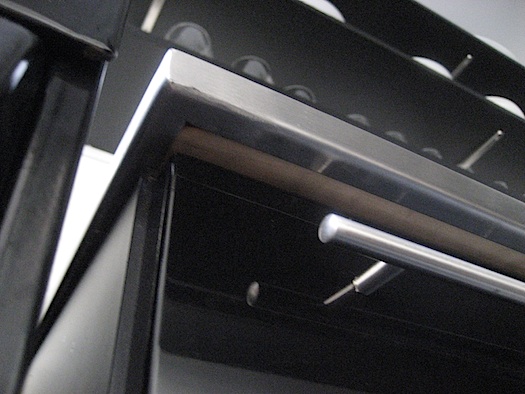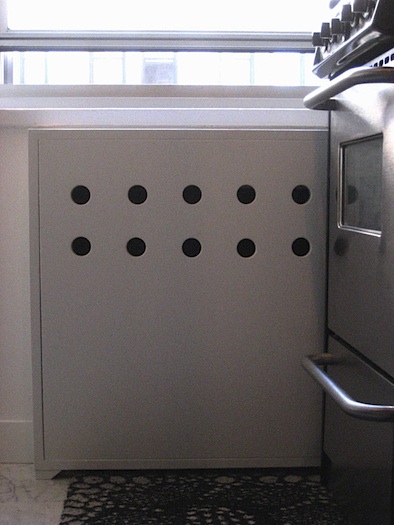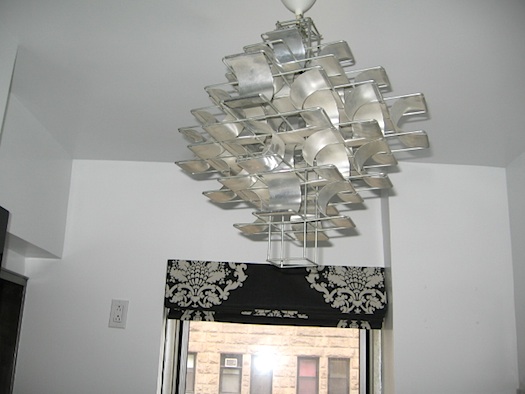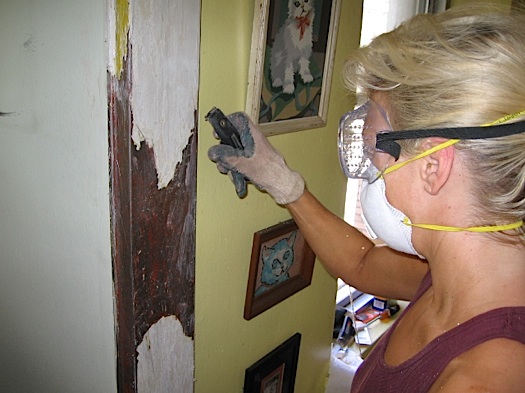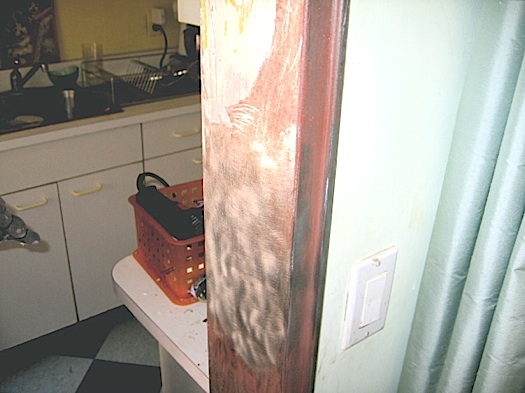
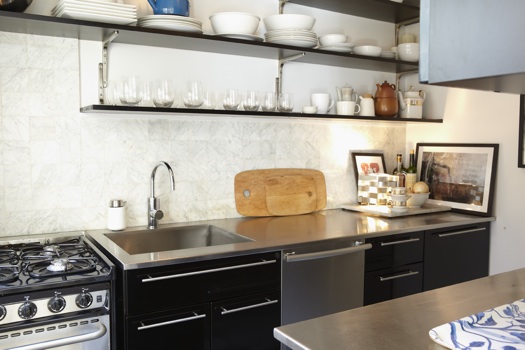
I’ve been circling the story of the transformation of ‘the improvised life’s new Laboratory from vin ordinaire apartment to its new incarnation of fluid, morphable, multi-use space for living and improvising (a glimpse above), wondering how to tell it. Having shown the early sketches and plans, it seems like the best bet would be to show BEFORE photos of the place as it was when I first found it, along with notations of the immediate challenges I saw, so you can get your bearings. I’ll get into the wild specifics of planning and renovation in the months to come.
Since moving, our space has gone from mess to order many times, as we unpack, settle, organize, in stages. Today, just as we thought we were through the worst of it, that is, AFTER we put the pots back on the finally-finished pot racks, all hell broke loose. Everything went wrong that could, as we tried to set up new phones (where IS the phone that’s ringing?) install the new AC to discover it was damaged, clean up the mess left from a project, help an ailing mother from afar, hire a new assistant, IMPOSE SOME ORDER and get this lovely place back to its airy minimal self. Every project we started got interrupted by another going wrong until finally we hit a wall. read more…
About a year ago, we wrote a post called “On Things ‘Not Looking Good While You’re Working on Them”, about the difficult – and often ongoing – “middle” of a project when things haven’t come together. We were heartened by artist John Currin‘s revelation about the creative process: the ONLY way to make thing anything happen is if you are able to endure the uncomfortable mid-point period of chaos and disorder, when things don’t look good.
Which is what we found on moving day 10 days ago. Despite our best efforts to complete our “simple” renovation (home of ‘improvised life’s new laboratory) and have things all pulled together when we moved into our new space, the movers arrived at the new space with a giant restaurant stove that was, inexplicably read more…
The Internet and phone are turned off in our old place; we’re camping amidst boxes. Needless to say, posting has been erratic…we spent 15 hours yesterday at the new space wrangling electricians, Fios guys, handiman, rug delivery.
We’re both overwhelmed and excited by the impending move to new digs, ‘the improvised life’s ongoing work-in-progress, a move from pre-war to modern.
We’re going dark for a week or so while we get things organized…and our wit’s about us. See you soon.
And big thanks for all who wrote to wish us well on the new space.
Never have we seen such a complete transformation of a house as that masterminded by Japanese architecture firm kurosawa kawaraten with just… paint – a paint job taken to the nnnth-degree. According to Design Boom:
“…none of the exterior or interior structure is changed, only a thin coat of white paint is applied to the surface. Only by adding white, the form is accentuated; white creates a modern and abstract version of the previous building.”
Modern and abstract is what this previously ordinary house became… read more…
For an interactive installation at the Queensland Gallery of Modern Art in Brisbane, artist Yayoi Kusama created a totally white room as a palette for visiting children to embellish as they pleased with colored dot stickers; ultimately thousands of stickers were used, to make bulls-eyes, whorls, dribbles and overlapping hits of color. The results of this crazy-simple exercise in spontaneous design is the increasingly stunning transformation of the white room…a big lesson to our often white-stuck decorating heads. Check out the transformation from start to finish…
(Video link here.) Our friend Maureen Rolla sent us this email; it is so expressive, it became a post:
“I am writing to tell you about a person and documentary that you should know about – it is called “Citizen Architect: Samuel Mockbee and the Spirit of the Rural Studio” – about an amazing architect, thinker, dreamer who ran a program called the Rural Studio at Auburn University in which architecture students designed and built homes, churches, and other structures for the residents of the very poor Hale County, Alabama. It is perhaps the best statement about the transformative power of architecture on regular human beings lives that I’ve ever seen (as opposed to big name, star power architecture that pretty much only benefits the star architect…) The students use some ordinary materials (hay bales, tires) in innovative ways to create some simple yet soaring projects. The film is available on Netflix (disk only, unfortunately). Unfortunately Mockbee died in 2001, only in his early 60s.”
We found a trailer for Citizen Architect (above) that makes us hungry to see the film. Check out this moving interview with Mockbee read more…
We always admire people who fearlessly take things apart on the way to REconfiguring them in a new way. So we love the antique table Faye from You are the River hacked, to give it a rustic/modern look; she salvaged rough-hewn top and added moderne legs. “I picked up a super funky table on Craigslist for $50, removed all the rusty screws, sanded it down, removed the legs and voila, I have yet another dining table!” It’s the legs that make it (They remind us of the one Sally designed out of black steel some time ago. read more…
After we posted Gary Chang’s 344 square foot Hong Kong apartment, we thought we’d pretty much seen the pinnacle of morphing possibilities for TINY. Until this morning, when we found ourselves riveted by this video of photographer Christian Schallert‘s 258 square foot Barcelona apartment (apx 11′ x 23′): a former pigeon loft re-envisioned by designer Barbara Appolloni. (Check out the “before” shots in the beginning!) We’ve seen this clever configuration of cubes likened to Legos, but find the image misleading. This completely built-in, every-need-and-square-inch-considered space is like one of those Chinese puzzle boxes that suddenly open to reveal hidden chambers; everything is hidden behind walls until Schallert wants to access it. It is an “action apartment”, given great charm by the stunning view and penthouse feel. read more…
Mondoblogo recently published this cell phone shot of a “my cousin’s” house AFTER a tornado set down on Tuscaloosa, Alabama, with these words:
“He is a 1st year law student on full scholarship at U of A. (Roll Tide) He and his wife Ceci are lucky to be alive. They were trapped in their bathroom until the Fire Department cut them out…. They literally have NOTHING left, only the clothes on their backs…
I post this only because you never know when something like this might happen to you or someone you love. So stop your griping, bitching and complaining about the little annoyances in life and get out there and enjoy it while you can, for as long as you can.”
Liz Massey of Creative Liberty blog featured an interview called with Sally in her April e-newsletter. Check it out here to learn how ‘the improvised life’ came about, and Sally’s rant-ette on the creative process, how cooking relates to improvising, and the benefits of adopting an improvisational frame of mind… Here’s an excerpt:
What advice would you have for someone who’d like to become more improvisational in their life, but is afraid to try? Fear, of course, can put the kibosh on anything if you let it. People tell me they are afraid they will fail, make mistakes, look like a fool, not be perfect, break the taboo of who they are “supposed” to be …
I view improvising as a practice: when you have an idea you’d like to try, even if you think you’ll be terrible at it, or that it will be a failure, ask yourself why not? and try it. If possible, suspend the inhibiting idea of doing things perfectly. If you are afraid of people judging you, work in private at first, but do it, take the step to see what happens if you try out your idea. Just doing that much is liberating. With practice, it gets easier and easier, and then there’s no way you cannot continue, because it is thrilling and incredibly illuminating.
Is there anything else on this topic you’d like to add? When you have an idea, I recommend asking yourself: “what would happen if …?” and “why not?”, and saying YES instead of NO frequently. Perfection is overrated. read more…
In this video, artist Francis Alys pushes a block of ice through the streets of Mexico City over a nine hour period, here edited down to 5 minutes. The cumbersome block gradually diminishes to the size of a tennis ball, until it finally melts into a puddle of water on the pavement. Writes artist Andrea Hickey :
“… stretching the object’s inexorable dissolution through the space of the city, the artist makes the point that progress is not inevitable – in short, that sometimes making something leads to nothing.”
It reminded of me the invisible town of Silica, in the West Virginia Appalachians, that I used to visit years ago. There was an abandoned camp on the grassy banks of a river: a schoolbus with a huge stone hearth built onto it, that I imagined a hermit to have lived in. The evidence of his life – newspapers, a few pots and pans – gradually got swept away by wind and rain and as the bus sank deeper into the ground each year, as though dissolving. That very spot was once the thriving town of Silica, which I’d seen pictures of: a glass factory, a store, houses, at the turn of the century. There was not a bit of it left, all fallen down, melted into the earth….
Still, although making something sometimes SEEMS to lead to nothing, that “nothing” is always SOMETHING: a memory, a lesson or idea for later use, or some passing effect that’s not often not apparent…one thing subtly reverberating with another…
We find something incredibly compelling about Marjin Van der Poll‘s Do hit chair: hammering a chair out of a metal cube with all one’s strength, testing it out, and then pounding and hammering and testing over and over until it takes shape. The cube is smashed full force with a hammer, until it becomes… something else, a solution.
“Do hit… is an interpretation of a chair by Italian designer Enzo Mari, the ‘sof-sof chair’. Its complex looking frame to me seemed a result of good craftsmanship but as it turned out it was one of the first examples of spot welding in the furniture industry. This contradiction between craftsmanship and mass production became the concept for the chair. Do hit started as a small copper model which I beat into a tiny chair with the pointed part of a hobby hammer. The cube would be easy to produce industrially and would be moulded into a chair using a hammer. Repetition of the beating only strengthened the concept…
The Do hit can either be shaped by its owner or by me. I have shaped many Do hits and look for an expressive object with large folds which I then polish to make them stand out. Each Do hit therefore is different as I can only create the global shape of seat and backrest and have to react to the detailed form taken on by the metal as it is being shaped. This is a great challenge every time.”
Of course, we followed the trail back to Enzo’s Mari inspiring chair, designed in 1971 read more…
Knowing that Lydia Wills was about to move to a bigger apartment, we enlisted Ellen Silverman to photograph her 600-square-foot studio near Gramercy Park. We’ve known Lydia for years and have watched her apartment evolve into a home with lots of good ideas, far too many to cover in one post. So we thought we’d do the broad strokes now and then focus on specifics during the next few weeks. The real story of Lydia’s apartment is that it slowly evolved, as Lydia did, growing out of one thing and into another, as she discovered furniture, fabrics and lighting that resonated with her life.
Lydia has been sewing since she was young and loves natural textiles, which she used to define the space (often incorporating unusual and vintage fabrics). Over years, she discovered and fell in love with the work of Scandinavian and European Modernist designers. She bought some enduring, beautifully designed pieces of furniture and lighting (mostly on Ebay, for a fraction of their cost), like the leather chair by Yngve Ekstrom, the fantastic table by Bengt Gullberg and the chandelier by Eric Hoglund.
Since there is nothing more gratifying than seeing before-and-after photos, we’ll start with a picture of what this apartment looked like BEFORE, when someone else had it: read more…