Interior designer Suzanne Shaker recently sent this email:
Sally, I’m craving your cherries in grappa. Would you please post the recipe again, as it is that time of year ..our last year’s supply is just about finished.
I’m making them for gifts as you always do.
A gift that lasts and brings such joy to the table.
I serve them in little green Moroccan glasses from John Derian, that we fill with the cherries and grappa and eat with a small spoon as we sip the syrup ..so comforting.
Suzanne is referring to the Dried Cherries in Red Wine Syrup recipe I devised years ago and published in The Improvisational Cook. (Last year, I gave her a huge jar to thank her for advising me on my apartment renovation.) They can be eaten as-is for a lovely, non-alcoholic,cherries-in-winter treat. Better yet, spike them with grappa, the clear Italian alcohol distilled from grape pressings. Somehow the earthy flavor of grappa marries with the cherries in an extraordinary way. Then they become a perfect, slightly boozy end to a meal, or a sleep-inducing midnight snack.
We found Emily Johnson through an architect a friend was working with. Emily’s drawings and plans were stunning. And although her focus was public spaces, the high level of her problem-solving abilities and imagination were apparent at the first meeting. We discussed our ideas with her. She suggested clever solutions to some of our design quandaries as well as people she knew that might help, from licensed architects to sign-off on final plans, to concrete floor finishers. She GOT what we were thinking.
Here’s what impressed us about Emily (and what to look for when interviewing any architectural plan-maker): read more…
(Video link here.) We were happy to see clever Snoopy pulling out a folding ping-pong table for his Thanksgiving crowd (along with an assortment of mismatched chairs). Covered with a cloth or kraft paper, nobody would know the difference.
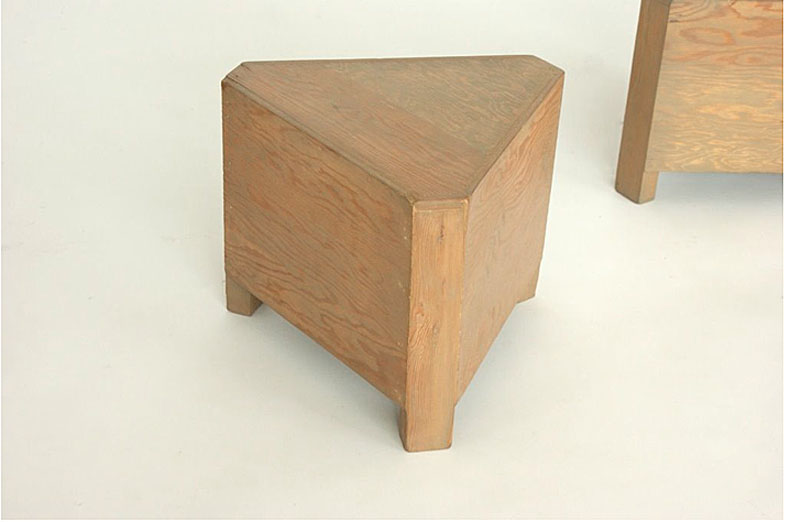
He isn’t the only one cobbling together a table. It’s a yearly scramble for many people around the holidays. Our strategy: a bunch of little tables placed in such a way as to make a perfect base of a 4′ x 8′ sheet of plywood ( or two if necessary), which can be used for projects later on. Sawhorses also make great, flexible bases.
When we wander around the city and see a discarded shipping pallet on the street, we mentally embrace its instant and deeply pleasurable design challenge: What could we make with this?
Lately, we’ve seen them cleverly used as day beds, with minimal work on the pallet itself, unless you feel like finishing or painting them. Stack ‘em and top with a foam slip-covered cushion. read more…
Recently on Unconsumption, we spotted these cool little cardboard benches made by A4A Design in Milan. The post mentioned that A4A has been a pioneer in designing cardboard furniture; that sent us looking for more, which we found at Inhabitat — a whole slideshow of them.
Anaylizing A4A’s designs, we realized that much of their furniture is made of stacked and glued sheets of honeycomb cardboard, a super-strong, lightweight and easily cuttable material. Since we know that the great Uline sells big sheets of honeycomb cardboard in thickness of 1/2″, 1″ and 2″ we thought: why couldn’t we make our own cardboard furniture? read more…
The wind has picked up in the huge trees in the park across the way. TV news is reporting mandatory evacuations around the city, as the confluence of full moon, the jet stream and hurricane Sandy’s massive size threatens major flooding and power outages. The sky is straight our of a Ghostbuster’s movie; we’re waiting for the storm to hit.
We spent the morning walking around Harlem gathering supplies, as others did…prescriptions, cash, batteries. We stopped to listen to the joyous gospel that spilled from the windows of a church. As we wandered, we planned our supplies and strategy should the power go out. We’re definitely not into Powerbars; but into REAL as long as we can maintain it.
(Video link here.) In this short TED talk, Graham Hill tells simple ways to start letting go of STUFF and getting rid of it. And why it is so essential.
1. Edit ruthlessly: clear the arteries of our lives, cut the extraneous out of our lives, think before we buy, ask ourselves, ‘Is that really gonna make me happier? Truly?’
2. New mantra: small is sexy. We want space efficiency, we want things that are designed for how they’re used the vast majority of the time–not that rare event. Why have a six burner stove when you rarely use three? So, we want things that nest, things that stack… we wanna digitize. You can take paperwork, books, movies, and you can make it disappear. It’s magic.
3. Think multifunctional spaces and housewares: a sink’s combined with a toilet, a dining table becomes a bed in the same space, a little side table stretches out to seat ten.
In the process of planning our Laboratory’s renovation, we called on a number of friends for advice: designers, artists, and people who just had plain good sense of one kind or another. When I told artist friend Lisa Morphew of the prices some of the contractors we’d spoken to were quoting us she said: “Honey, what you want to do isn’t rocket science. It shouldn’t cost so much.” Lisa, who had worked construction and transformed a wreck of a house in North Carolina into a wondrous space, proceeded to give us a lesson in how our place was made.
Pointing to the sheetrock wall that bisected the living rooms and second bedroom which we were dying to take down, she said “I could take that down with a shovel if you have one. I’ll show you how easy it is, and you’ll understand how it’s made”. A shovel?!! We didn’t have a shovel on hand so we went around to the hardware store and bought one then and there. We weren’t going to miss the chance to see that wall come down.
Lisa, and a friend, proceeded to demolish the wall in less than half an hour. read more…
We’ve browsed endless catalogues that feature chic, expensive house numbers. We’ve always preferred the ones Isabel Rower devised out of washi tape. Then we saw THIS wonderful graphic house number done in ordinary paint. It could be any size and color(s) you want. The trick would be in finding or making a template that makes for beautiful lines, though freehand could be really beautiful.
We’re crazy for rusted metal. We love the intentionally-rusted corton steel planters used at the High Line have amassed a strangely beautiful collection of pieces we’ve found in our wanderings, like the three-sided forms we use as book or artwork stands. So we were smitten when we saw images of this very modern house designed by Blank Studio, with its juxtaposition of rusted corrugated metal and plexiglass. It made us run to look up how to intentionally rust corrugated metal (which you can do using photo acid and other methods).
It gave us some ideas for the ancient garden chair we’ve set out on the terrace to see what would happen if we let it rust, intentionally. read more…
Lush, fragrant summer strawberries are in their last week or two at farm stands. We bought some home and were inspired to serve them in the giant horn spoon Maria Robledo had given us, for an unexpected presentation. We ate them right off the stems, no powdered sugar necessary. It reminded us that there are all kinds of charming and unexpected vessels you could use for serving summer berries. We imagined an our collection of big odd serving spoons filled with berries and arrayed on the table.
If you decide to remove the hulls before serving the berries or cooking with them, don’t throw them away: they can make a great instant flavoring for balsamic vinegar. read more…
I recently wrote that the first step in planning our renovation was to hang out in the space and dream. That’s not quite true. That step ran concurrently with friends coming over to give their 2-cents and help us explore how exactly the place was made. By explore I mean busting holes in ceiling and walls I thought about demolishing to actually see what lay hidden in them — elecrical wiring, support columns, pipes — in order to plot possibilities.
The first thing several friends noticed was how low the ceiling felt at 8’2″. (This proved to be largely due to the way the place was painted and the height of the doors). My friend Holton Rower decided that it was imperative that we see if there was any space above them hoping it might be possible to raise them. In lieu of a ladder, Holton rigged a platform with what was around: read more…